At a glance
- List who owns each item and which tools are shared.
- Trace each person’s working area before assigning tray space.
- Reset and hand over the desk with a short return check.
Two people can share a desk without turning every changeover into a search for pens, notes, or keys. Start by listing each person’s personal items and the tools both people use. Mark the area each person needs while working, then assign a return place to every loose item. A short handover check makes it clear what stays, what moves, and who should return shared tools.
The method does not guarantee that two full work setups fit at once. Measure your own desk and test one arrangement at a time. A tray can contain small items, but its outside dimensions do not establish usable space or prove that a keyboard and mouse area remains clear.
Inventory personal, shared, and reserve items
Clear the loose items off the desk and sort them into three groups. Personal items belong to Person A or Person B. Shared tools include the charger, stapler, or reference book both people use. Reserve items are not needed during the current work session and can return to a drawer or shelf.
Write down the owner for anything that is easy to confuse. If each person uses a similar pen or notebook, add a name or a visual marker that does not damage the item. Do not assume that an object left near one chair belongs to that person; agree on ownership before assigning a permanent parking spot.
Trace the active work envelope for each person
Put the actual keyboard, mouse, notebook, and monitor back where they are used. Trace their working areas on paper or with removable notes. Include the mouse’s full movement path and the page area needed for writing. When the desk is shared sequentially, record each person’s setup separately. If both work at once, mark both envelopes and look for overlap rather than assuming they can coexist.
Keep the shared surface clear enough for the task at hand. A tray should sit outside the working envelope if possible; it should not occupy the space needed for a hand, mouse, paper, or device stand. If the desk is too small, keep personal supplies in a nearby drawer or shelf and bring them over only for that person’s session.
Assign a return destination before moving items
Choose one location for each personal group and one for shared tools. A label, a named tray, or a consistent left/right side can work if both people can reach it without crossing the active work area. The important part is that the destination has an agreed owner and that shared items return there after use.
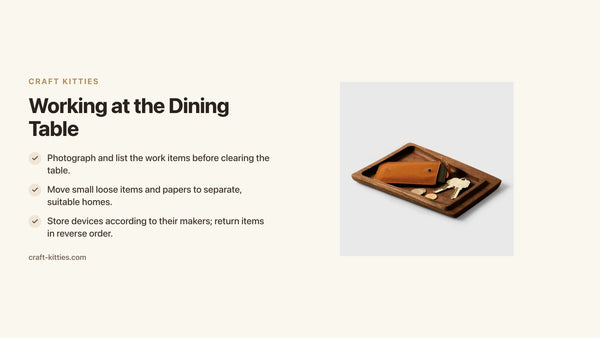
For loose objects, compare each candidate tray’s outside footprint with the free space you measured. The hardwood valet desk tray is listed at 195 mm high × 85 mm wide × 220 mm deep. The hardwood valet tray and key rack is listed at 200 mm high × 120 mm wide × 290 mm deep. Those overall dimensions do not establish the usable compartment size or whether either item fits between your devices and hands.
| Owner | Active, shared, or reserve state | Return destination | Handover check |
|---|---|---|---|
| Person A’s notebook and pen | Personal, active during A’s work block | A’s marked side or a nearby shelf | A confirms both are returned before leaving |
| Person B’s mouse or adapter | Personal, active during B’s work block | B’s container or named drawer | B checks the working area before starting |
| Stapler or charger used by both | Shared, active when needed | One common labeled spot outside the keyboard area | Last user returns it and notes any fault |
| Extra stationery not needed now | Reserve | Shared supply drawer | User takes only what the next task requires |
| Loose note that contains an unfinished task | Personal or shared according to its owner | A dated notebook or suitable paper folder | Owner records what must happen next |
This table is a starting inventory. Add rows for your own objects rather than treating it as a universal desk list. If both people need the same tool at the same time, decide whether to schedule use, keep a second tool, or move the task; do not assume that one item can serve both simultaneously.
Use trays as containers, not as a layout guarantee
A tray can give small objects a repeatable home. It cannot make a crowded desktop larger. Put the tray in the traced free area, then restore the keyboard, mouse, and paper. If any active item now sits outside its comfortable route or a hand repeatedly hits the tray, revise the layout or use storage elsewhere.
Avoid filling a tray just because it has unused corners. Reserve items that do not belong to either person’s current task should leave the desktop. If the tray’s internal dimensions are not listed, test actual objects or ask the maker rather than calculating from the external measurements.

Description

Description
Make changeover a short handover, not a desk reset project
At the end of a work block, each person returns personal items to their assigned place, puts shared tools in the common spot, and moves unfinished notes into a named notebook or folder. The next person checks the active work area before setting up. If something is missing, ask its owner or check the agreed destination instead of moving every object on the desk.
Keep the handover focused on the status of the desk: what remains active, what is shared, and what is waiting for the next session. A short note such as “charger in common tray; printout in blue folder” is more useful than leaving an unlabeled pile. Do not leave confidential or valuable papers in an open common area; the person responsible should put them in an appropriate enclosure or secure location.
Separate work setup from room decoration
Room styling and desk workflow overlap, but they answer different questions. A wood organizer may add a visual accent, while the desk plan must still preserve working space and clear ownership. For broader layout ideas, see decluttering a home office desk and home office setup ideas. This guide focuses on the handover between two users and the location of objects that belong to one or both of them.
When caring for a wooden tray, use its maker’s finish instructions. The USDA Forest Products Laboratory explains that finish choice affects cleanability. The National Park Service notes that dust is abrasive and should be collected rather than rubbed across wood. Those sources inform surface care, not desk capacity or fit.
FAQ
How do two people organize one desk?
List personal, shared, and reserve items, trace each person’s active work area, then assign a return destination. If both setups overlap, test them separately or plan a schedule instead of assuming simultaneous fit.
Should each person have a separate tray?
Only if the desk has measured room for it outside the active keyboard, mouse, and paper areas. A nearby drawer or shelf may work better than adding more containers to a crowded surface.
What belongs in a shared-tool area?
Put only items both people use there, such as an agreed charger or stapler. Assign one return location and make the last user responsible for putting it back.
How do I avoid losing notes during a changeover?
Move unfinished notes into a named notebook or suitable folder and record the next action. Keep private or valuable paperwork in an appropriate enclosure rather than in an open shared tray.