At a glance
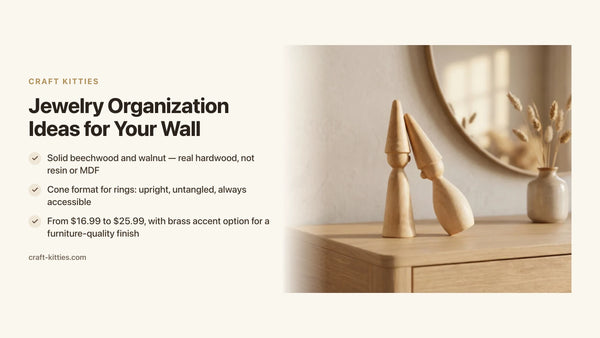
- Genuine solid wood — beechwood, walnut or red oak, never veneered
- Ring cone sets from $16.99, with or without brass base
- Works for rings, pendant necklaces and stud earrings in one compact footprint
The jewelry drawer is one of those household objects that everyone owns and no one really intends to own. It starts with a velvet insert that came with a department store purchase, accumulates a few folded tissues, loses its lid, and gradually becomes the place where rings go to be forgotten. The upgrade is smaller than it sounds: a single wooden ring holder on the dresser top changes the entire habit. Jewelry comes off, lands on the cone, and is visible and accessible the next morning — no tray to rummage, no drawer to close.
The catch, as with any wood piece you will look at every day, is choosing correctly. Beechwood or walnut, a single cone or a matched set, with or without a brass base — the options are close in photo but distinct on an actual dresser. This guide walks through every criterion that shapes the decision: wood species, cone geometry, base hardware, the set-of-two logic, and care. Then it presents our studio's three ring holder models with their prices, a comparison table, a decision matrix and the questions we hear most often.
One point up front, because everything downstream depends on it: this guide is about genuine solid wood. Resin ring holders chip at the base. Veneered wood splits at the point of the cone after months of friction. Waxed solid hardwood — beechwood, walnut, red oak — wears like a piece of furniture: it develops a subtle patina over time instead of degrading. That distinction is the reason the wood species section comes first.
At a glance
- Genuine solid wood — beechwood, walnut or red oak, never veneered
- Ring cone sets from $16.99, with or without brass base
- Works for rings, pendant necklaces and stud earrings in one compact footprint
Beechwood, walnut or red oak: the species decision

The species question is almost entirely visual. All three hardwoods we work with — beechwood, walnut and red oak — are cut from genuine solid wood, shaped on a lathe, sanded smooth and finished with a wax coat. The cone geometry, the fit on a ring, the smoothness underhand: identical. What differs is the tone and the grain character, which is the thing you will register every time you walk past the dresser.
Beechwood is the palest of the three: a creamy white to light honey tone with a fine, even grain that is nearly invisible at arm's length. On a dresser with dark tones or rich bedding it reads bright and clean, a deliberate contrast. On a white or off-white surface it blends softly, almost Scandinavian. The Beechwood Ring Holder Cone Set pairs two beechwood cones in slightly different heights — a design choice that makes the duo more dynamic than two identical silhouettes.
Walnut sits at the opposite end of the palette. Real solid walnut — not a walnut stain applied to a cheaper wood — is deep brown with a fine, close grain and occasional feathering that catches the light at certain angles. Against a light dresser surface, a walnut cone reads as a considered accessory rather than an afterthought. The Walnut Wood Ring Holder with Solid Brass Base takes this further: the contrast between the dark wood and the warm brass creates something close to jewelry-counter quality at dresser scale.
Red oak is the middle path: honey-warm with a pronounced, open grain that you can read clearly from across the room. It is the most traditional American hardwood aesthetic — familiar, grounded, visually bold. The Wooden Ring Holder Set of 2 in Walnut uses walnut as its default, but red oak alternatives exist in our lineup for anyone who prefers the lighter, warmer look.
The reliable decision framework is contrast: match the holder to what is opposite the dominant tone of your dresser. Dark wood dresser — beechwood cone, palest option. Light or white furniture — walnut, deepest contrast. Mid-tone or mixed setting — red oak, the natural bridge.
The cone shape: why geometry matters for daily use
A ring holder is a simple object. Its geometry still has meaningful consequences for how useful it is day to day.
The profile of the cone determines three things: how many rings stack before they crowd each other, whether rings stay put when you bump the dresser, and whether removing a specific ring from the middle of a stack is possible without removing all the others. A cone that tapers too sharply gets rings wedged at the tip; one that is too shallow lets rings slide together in a mass at the base.
Our cones are proportioned to hold three to five rings in a stable stack, each resting on the slightly tapered surface above without binding. The tip is turned smooth and rounded — no raw point that could catch a prong. The base is wide enough to resist tipping on a standard dresser surface, which matters more than it sounds when the cone is next to a perfume bottle or a lamp.
The height differential in the cone set — one cone slightly taller than its pair — serves a practical purpose beyond aesthetics. Rings you reach for every day (a wedding band, a daily signet) go on the shorter cone: lower, easier to grab without looking. Statement rings or occasional pieces go on the taller cone: elevated, visible, clearly intentional. The dresser top organizes itself without requiring a sorting ritual.
Set of one or set of two: the couple question
A single ring holder makes sense for a minimalist collector or a small dresser. A set of two makes sense for almost everyone else, and not just for couples.
The most practical argument for a set-of-two is the separation of everyday versus occasional. Rings you wear daily — the ones that need to be on your hand before you leave the room — live on one cone. Rings you rotate into heavier or dressed-down rotation live on the second. The visual separation removes the daily decision entirely: the right cone becomes automatic.
For partners sharing a dresser, the logic is obvious. The Beechwood Ring Holder Cone Set is listed as a couples set explicitly: two cones, slightly staggered heights, designed to sit side by side without crowding the surface. The design is symmetrical enough to read as a matched pair, asymmetrical enough to avoid looking like a store display.
For a single dresser, two cones also give you one permanent slot for rings that should never leave the house — a vintage piece, an heirloom that is too delicate for daily wear — and one slot for everything in active rotation. That separation prevents the worst-case scenario of the everyday ring getting mixed in with the once-a-year ones in a velvet tray.
Brass base or no base: the hardware question

The solid brass base on our Walnut Wood Ring Holder with Solid Brass Base serves two functions that are easy to miss in a product photo. First, weight. A coned ring holder without a base is light enough to tip if a ring slides on at an angle or if the dresser gets bumped. A solid brass base lowers the center of gravity so the piece stays upright under normal handling. Second, visual grounding. The brass plate at the base gives the eye a landing point — the cone reads as a designed object set on a surface rather than a wooden peg that happens to be standing there.
The trade-off is footprint and flexibility. A single walnut cone on a brass base takes more dresser real estate than two cones without bases, and it is less easy to move or group with other pieces. For a single, deliberate statement piece — especially one that might double as an engagement ring display — the brass base version is the clear choice. For a matched set of two sitting together, the cones without bases read cleaner and leave room for a candle or a small tray alongside.
The finish matters too: solid brass, unlacquered, develops a subtle warm patina with time rather than staying aggressively shiny. This is what separates real brass from brass-plated zinc: one ages into the dresser, the other looks like it was installed yesterday for the next decade.
The five products in our lineup

Description
The beechwood set is the most accessible entry point in the lineup: two genuine beechwood cones, pale and fine-grained, turned to slightly different heights so they read as a designed pair rather than two duplicates. At $16.99 it is the starting price for solid hardwood in this format — well below what a jewelry store charges for a velvet display holder that will pill and flatten inside a year. Stack three to five rings per cone, drape a pendant necklace around the stem, and the dresser top acquires a surface that stores and displays in the same gesture.

Description
The walnut-and-brass combination is the one we point to when the question is "which one looks most like it belongs." The walnut cone is cut from genuine solid walnut — not a stain, not a veneer — and the brass base is solid, unlacquered, and heavy enough to keep the cone stable even under the friction of daily ring removal. At $25.99 it is the premium end of the lineup, and the one most commonly used as an engagement ring display or a housewarming gift. The brass develops a warm patina with time; the walnut deepens slightly. Both age better than new.

Description
The walnut set of two occupies the mid-point: the depth and warmth of walnut without the added weight of a brass base, in the two-cone format that handles a full daily rotation. At $18.99 it is the right pick when the dresser has limited depth and you want both cones to sit flush without a base extending the footprint. The pair works for shared use or for anyone who separates rings by frequency — daily rotation on one cone, occasional pieces on the other.
Comparison table
| Model | Price | Wood | Base | Best for |
|---|---|---|---|---|
| Beechwood Cone Set | $16.99 | Solid beechwood | No base | Couples, bright dressers, entry price |
| Walnut + Brass Base | $25.99 | Solid walnut | Solid brass | Statement piece, gift, engagement display |
| Walnut Cone Set of 2 | $18.99 | Solid walnut | No base | Shared dresser, daily/occasional split |
Decision matrix — which model for which situation
| Your situation | The right pick |
|---|---|
| Light dresser, you want the warmest contrast | Walnut + Brass Base |
| Dark dresser, you want something that brightens it | Beechwood Cone Set |
| Shared dresser, two people sharing space | Beechwood Cone Set or Walnut Set of 2 |
| Single statement piece, engagement ring display | Walnut + Brass Base |
| Gift for a couple moving in together | Beechwood Cone Set |
| Walnut tone, limited dresser depth | Walnut Set of 2 |
| Best price for genuine solid wood | Beechwood Cone Set — $16.99 |
How to style a ring holder on the dresser top
A ring holder has a second life as a styling element, which is worth thinking about before placing it. Dropped in the middle of a dresser it competes with everything. Positioned at a corner, near where you undress, it anchors the surface without claiming visual territory it does not need.
The most functional layout puts the cone set at the front corner of the dresser on the side of your dominant hand. Rings come off first when you undress — the holder should be the first surface your hand reaches. A candle or a small plant slightly behind the cones, at a different height, gives the arrangement depth without cluttering it.
If you have the walnut-and-brass single cone and want to extend the dresser-top composition, a shallow wooden tray for bracelets alongside the cone creates a contained zone for all daily jewelry. The whole surface reads as intentional rather than accumulated — which is the actual goal of any dresser-top organizer.
For jewelry photography, and particularly for engagement ring photos, the walnut cone with brass base creates a natural pedestal. Position it on a light surface, natural light from the side, and the ring rests elevated with shadow below — which is exactly how jewelry photographers stage rings without a dedicated display stand.
Common mistakes that limit a wooden ring holder's usefulness
Choosing the wood from the screen rather than from the dresser. A beechwood cone that looks pale and neutral on a monitor can look almost white next to a warm-toned wood dresser. Before ordering, hold a piece of white paper against the dresser surface and observe the gap between the paper white and the dresser tone — that gap is roughly how much a beechwood cone will stand out. If you want a quiet blend rather than a contrast, go walnut.
Placing the cone where it looks good instead of where you will actually use it. A ring holder at the back of the dresser, behind the perfume and the lamp, becomes a display rather than a storage tool. It should sit within reach from a standing position, at the corner you naturally face when undressing. Two minutes of honest placement testing before committing prevents months of rings landing on the dresser surface next to the holder.
Stacking too many rings on one cone. The geometry works best at three to five rings. Above that, lower rings start to bind against each other, and removing a specific band from the middle of the stack becomes a minor operation. If the collection has outgrown one cone, adding a second is a cleaner solution than crowding the first.
Ignoring the necklace capacity. The cone stem is long enough to drape a pendant necklace around it without the pendant touching the dresser surface. This doubles the holder's utility without adding any footprint — a detail that is worth knowing before buying a separate necklace stand.
Care and longevity
The wax finish on all three models requires almost no maintenance. A dry cloth removes dust; a slightly damp one handles fingerprints or dried perfume droplets. No product needed, no conditioning ritual. The one thing to avoid is leaving the cone in direct contact with a wet surface, such as a bathroom counter after cleaning — solid wood is moisture-tolerant when waxed but not immune to prolonged standing water.
Over time, the wax finish may show slight wear at the contact point of the heaviest ring. This is not damage — it is wear, which is what solid wood does instead of chipping. If you want to refresh the surface after a year or two, a thin coat of furniture paste wax, buffed lightly, restores the original sheen in ten minutes. No sanding, no stripping, no specialist product.
The brass base on the Walnut Wood Ring Holder with Solid Brass Base ages separately from the wood. Unlacquered brass oxidizes slowly into a warmer, slightly darker tone — a process jewelers call patina and decorators call character. If you prefer the original bright tone, a jewelry polishing cloth once or twice a year maintains it. Both approaches are correct; it is a question of whether you prefer the piece to stay new or to evolve.
What to pair with a wooden ring holder
A ring holder addresses the most urgent part of the dresser-top organization problem — rings, pendants and small earrings. The second tier, usually bracelets and watches, benefits from a shallow wood tray or a small dish alongside. Our ring holder collection includes complementary pieces designed in the same wood families, so the dresser surface reads as a composed set rather than an assembly of independent decisions.
For a bedroom that already has other wood accents — a lamp base, a side table, a picture frame — the ring holder is the piece that completes the palette on the dresser. Beechwood against beechwood reads as a family; walnut against walnut reads like an interior with a point of view. The dresser top is a small surface with a disproportionate visual presence in a bedroom, because it is the surface you face in the morning and return to at night. It is worth taking two minutes to choose the right tone.
FAQ — wooden jewelry tray organizers and ring holders
1 — Is beechwood or walnut better for a ring holder? Both are genuine solid hardwoods — the choice is purely about tone. Beechwood is pale and fine-grained, brightest on a dresser surface. Walnut is deep brown with a tight grain, reads as more elevated or furniture-like. Choose by contrast with the surface it will sit on: dark dresser, go beechwood; light dresser, go walnut.
2 — Will the cone scratch my rings? No. The cones are turned smooth and wax-finished with no raw edges or abrasive points. Rings slide on and off cleanly. The wax surface is softer than the metal of most bands, so friction runs in the right direction.
3 — How many rings fit on one cone? Three to five rings per cone stack comfortably without crowding. For larger collections, a set-of-two gives six to ten slots, or two sets side by side can organize a full rotation. Stacking beyond five rings makes individual retrieval harder.
4 — Can a wooden ring holder work as an engagement ring display? Yes — and it is one of the most photographed uses. The walnut cone with brass base is a common choice for this: the contrast between dark wood and warm brass creates a presentation-quality display without the velvet-box aesthetic.
5 — Is solid wood better than velvet or resin for rings? For daily storage, yes. Velvet pills and attracts dust; resin chips at the edges and can yellow with UV exposure. Waxed solid beech, walnut or red oak wipes clean, resists perfume residue, and stays smooth for years. For transport, a padded case is still the right choice — wood is not padded.
6 — What other jewelry pieces fit on a ring holder? Pendant necklaces draped around the stem, stud earrings pushed into the base, small bangles slipped over the tip. The cone holds more than rings — it is a compact all-in-one valet for the pieces you reach for first.
7 — Does a wooden jewelry organizer make a good gift? It is a reliable gift because it is visible, used daily, and feels considered rather than generic. The walnut-and-brass single cone reads as a deliberate design choice. The beechwood set works specifically for couples moving in together or celebrating an anniversary.
8 — How do I clean a wooden ring holder? A dry or lightly damp cloth handles dust and fingerprints. No product needed. Avoid prolonged contact with standing water. A thin coat of furniture wax once or twice a year refreshes the surface if it shows wear at the contact points — but it is optional, not required.
9 — Where should I place a ring holder on the dresser? At the front corner, on the side of your dominant hand, within easy reach from a standing position. This is the spot closest to where rings come off and where you will reach for them first without looking. Placement at the back of the dresser turns a storage tool into a display only.
10 — Can I use one cone for both rings and a pendant necklace? Yes. The stem is long enough to drape a pendant necklace without the necklace touching the dresser surface. Rings stack in the lower half of the cone; the pendant hangs from the upper half. It is a small detail that doubles the holder's utility without adding footprint.
Where to go next
The ring holder is usually the first solid wood piece that lands on a dresser — rarely the last. Our ring holder collection covers the range from the entry-level beechwood cone set at $16.99 to the walnut-and-brass statement piece at $25.99. If you are building a full dresser-top arrangement — rings, bracelets, watches — the collection includes complementary pieces designed in the same beechwood and walnut families so the surface reads as composed rather than assembled.
We have 243 reviews on Etsy from buyers who made this same decision — the most common note is that the holder looks significantly better in person than in the product photo, which is a function of how solid wood catches light differently than any screen can render.
One rule and three picks
If this guide leaves you with one method: choose the species by contrast with your dresser surface, and pick the cone count by your actual ring volume, not by the minimum. The beechwood cone set is the answer for shared dressers and bright surfaces; the walnut-and-brass single is the right choice when a statement piece or a gift is the goal; the walnut set of two occupies the middle path — warm tone, matched pair, no extra footprint from a base. Three options, one surface, a dresser top that finally has a system.