At a glance
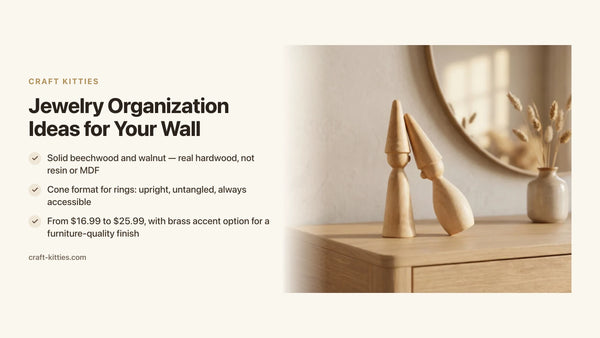
- Solid beechwood and walnut — real hardwood, not veneer or MDF
- Tapered cone format keeps rings separated and stone-safe
- From $16.99 for a set, with brass base option at $25.99
A ring holder is one of the smallest objects on a dresser and one of the most used. It comes off at night and goes back on in the morning — every day, without exception. Which makes the choice of material matter more than the size of the object would suggest: a wooden cone in solid beechwood or walnut handles that contact gracefully, improving with use rather than degrading. A plastic holder or a dish in thin veneer does the opposite.
This guide covers what to look for when choosing a wooden ring holder — wood species, form factor, base design, what cone geometry does that a flat dish does not — and presents the models from our studio in detail, with a comparison table, a decision matrix, and answers to the questions that come up most often. The products are straightforward; the guide is here because the differences between them are small on the product page and real in daily use.
One thing to establish clearly before the rest: this guide is about solid wood. Ring holders described as "wood" but built from MDF, bamboo composite, or thin veneer reveal that distinction within weeks of daily contact — the surface chips at the tip, the base warps with humidity, the finish dulls unevenly. Solid beechwood and solid walnut age like furniture: the patina deepens, the surface stays smooth, the object looks better at year three than it did on day one.
Why wood — and why the species matters

The choice of wood species for a ring holder is aesthetic first and functional second — but the functional differences are real enough to note.
Beechwood is one of the hardest domestic hardwoods. Its grain is tight, uniform and nearly invisible at normal viewing distance, which gives a beechwood cone a clean, almost ceramic quality. The surface sands to a very smooth finish, so rings slide on and off without any catching sensation — relevant if you wear a solitaire with a raised prong setting. The tone is pale and warm, somewhere between cream and honey, which makes it easy to read on a dark surface and equally easy to pair with light-toned furniture.
Walnut is the darker option. Its grain is finer than red oak, and its deep brown tone has been the most sought-after wood in home objects for a generation. Against a light dresser surface it reads as a deliberate choice; in a darker room it adds depth without disappearing. The surface is slightly warmer to the touch than beechwood — a minor tactile difference most people notice only if they handle both side by side. Walnut's reputation as a premium material makes it the natural pick for a gift.
The functional conclusion: either species is an excellent material for a ring holder. Both are solid hardwood. Both are finished with a smooth, sealed coat that is stone-safe and static-free. The choice, in practice, is about the tone you want on the surface and the context — personal use or gift — that drives the purchase.
The case for a tapered cone over a flat dish
A flat ring dish is the most common format found in jewelry storage, and it has one genuine advantage: it holds other objects too — small earrings, a chain, a key. The ring itself simply drops in, which is fast and effortless.
The cone format gives up that versatility in exchange for something more specific to rings: vertical separation. A ring placed on a cone rests at a height on the taper determined by its inner diameter. A size 5 band will sit near the tip; a size 8 will rest lower. Two rings placed on the same cone are physically separated in space — the upper ring cannot press against the lower ring's prongs, and the lower ring cannot scratch the upper ring's band. For someone who removes rings every night, the cone eliminates the small anxiety of stacking rings in a dish where a diamond tip touches a plain gold surface overnight.
The hand-shaped variant of the cone format takes this further by making the separation visual as well as physical. A carved wooden hand places each finger as a distinct display point, which makes the arrangement readable at a glance — left-hand rings on one hand, right-hand rings on the other, or everyday rings versus occasion jewelry. It also converts the ring display into a small sculptural object, which is why hand-shaped ring holders appear consistently in bedrooms where the dresser is part of the décor rather than a purely functional surface.
The base question: weighted, brass, or integrated
The cone is the most visible part of the ring holder, but the base determines how it actually sits on a surface.
An integrated wood base — where the cone and its platform are cut from the same piece — keeps the object light and uniform. It is the right format for a nightstand or a bathroom vanity where surface space is tight, and it is the format that scales most naturally into a two-cone or three-cone set, since two bases side by side read as a pair rather than two competing objects.
A solid brass base changes the character of the piece. The weight of the base grounds the cone so it does not shift when you place or remove a ring at speed. The visual contrast between dark wood and warm gold metal mirrors the aesthetic of fine jewelry itself — which is exactly what a walnut-and-brass ring holder communicates when someone enters a bedroom and sees it on the dresser. It is the format that most naturally positions a ring holder as an object in its own right rather than a tool.
For couples, the two-cone set solves the practical problem that a shared dresser creates: whose rings are whose, and do they interfere with each other at night. Two cones side by side establish distinct territories without requiring a second dish or a divided tray.
Our ring holders, in detail
Four models, from the entry-level beechwood set to the walnut-with-brass piece, chosen to cover the four buyer contexts that come up most often: the minimalist personal user, the couple sharing a dresser surface, the buyer looking for a statement gift, and the person who wants to display a small collection rather than just store it.

Description
The Beechwood Ring Holder Cone Set is the starting point in our lineup and the most versatile model we make. Two tapered cones in solid beechwood, set on a shared wood base, designed to sit side by side on a dresser, a nightstand, or a bathroom vanity. The pale warm tone of beechwood makes the rings the focal point rather than the holder, which is the right hierarchy when the jewelry itself is the statement. The cones are sanded to a smooth, sealed finish so prongs do not catch on the surface during removal. At $16.99, it is the case that solid hardwood does not require a premium price to be the right choice.

Description
The Walnut Wood Ring Holder with Solid Brass Base is the model we suggest when the answer to "what occasion is this for?" involves someone else. The cone is solid walnut, finished smooth; the base is solid brass, heavy enough to keep the holder completely still on a polished surface. The visual logic is simple: dark wood against warm gold is the same contrast that fine jewelry itself is built on. It sits on a dresser and reads as intentional rather than functional — which is the difference that justifies the $25.99 price relative to a dish or a simple dish-style tray. It is also, practically, the most gift-ready format we make: it ships as a complete object that requires no assembly and no context to understand.

Description
The Wooden Ring Holder Set of 2 in Walnut takes the same logic as the beechwood set but in walnut's darker register. Two cones, two bases, each piece in solid walnut finished to a smooth coat. The format is designed around two use cases that come up equally: a couple sharing a dresser surface, where each cone belongs to one person, and a single user with a rotation — everyday rings on one cone, occasion rings on the second. At $18.99, it is $2 more than the beechwood set because walnut commands a modest premium as a material — a premium that is visible in the grain and the tone the moment the two cones sit side by side on a surface.
Comparison table
| Model | Price | Wood | Base | Best for |
|---|---|---|---|---|
| Beechwood Cone Set | $16.99 | Solid beechwood | Integrated wood | Daily use, shared dresser, light surfaces |
| Walnut + Brass Base | $25.99 | Solid walnut | Solid brass (weighted) | Statement piece, gift, dresser anchor |
| Walnut Cone Set of 2 | $18.99 | Solid walnut | Integrated wood | Couples, walnut tone preference, collection display |
Decision matrix — which holder for which situation
| Your situation | The right pick |
|---|---|
| Light dresser surface, minimal look, ring holder as tool | Beechwood Cone Set — $16.99 |
| You want the holder to be the statement, not just the rings | Walnut + Brass Base — $25.99 |
| Two people sharing a dresser, same wood tone preferred | Walnut Cone Set of 2 — $18.99 |
| You rotate between everyday and occasion rings | Walnut Cone Set of 2 — $18.99 |
| Gift — anniversary, birthday, or housewarming | Walnut + Brass Base — $25.99 |
How wood ages versus other materials

A wooden ring holder is not the only format on the market, and the comparison with the alternatives clarifies what wood is actually doing.
Ceramic is the most common alternative. It is heavy, which is a genuine advantage for stability, and the glaze is smooth enough for most rings. The failure mode is impact: a ceramic cone dropped onto a hard surface chips at the base or the tip, and a chipped ceramic surface is rough enough to catch a prong. Ceramic holders also tend to attract dust via static charge when left on a surface, which means the ring comes off a cone coated in fine particles.
Acrylic and lucite are popular in translucent and colored formats. The surface is smooth and the material is light, which makes it easy to position anywhere. The long-term problem is that acrylic scratches easily and static charge is even more pronounced than with ceramics — an acrylic holder in a dry environment will gather visible dust on its surface within days. For everyday contact with a ring that you value, a static-free material is the quieter choice.
Metal trays — typically brass, gold-plated steel or blackened iron — are the format most often found in grooming or vanity sets. A plain metal tray is the most stone-safe format of all, because there is no texture to catch a prong. The trade-off is that a thin band placed in a metal tray can contact the tray surface and, over years, show fine surface marks from that repeated contact, particularly on gold.
Solid sealed wood sits in a useful middle position: harder than acrylic, less prone to impact damage than ceramic, smoother in long-term contact than a bare metal tray. The surface is static-free. The finish is sealed so rings do not contact bare grain fibers. And unlike any of the alternatives, solid wood improves with age — the patina of a beechwood or walnut cone after two years of daily contact is warmer and deeper than when it arrived.
Positioning a ring holder on the dresser
Placement matters more than most people expect, and the common mistake is to put the ring holder where there is empty space rather than where the hand naturally moves.
The right position is wherever your hand goes first when you enter the room after a long day. For most people that is the corner of the dresser closest to the door — the spot you pass before anything else. Placing the holder there means the ring comes off in one motion, without a detour across the dresser surface, and goes back on the same way in the morning.
If the holder is part of a larger dresser arrangement, the visual rule is straightforward: group it with objects of similar height. A ring cone next to a full-height perfume bottle reads as clutter; next to a small candle or a low jewelry tray it reads as composition. The rule is not strict — it is simply that the eye prefers objects that share a horizon line when they sit on the same surface.
For couples who share a dresser, two cones at the same height side by side read as a pair. Putting them at the same distance from the edge and the same distance from each other establishes a visual rhythm that makes the surface feel organized even when everything else on it is not.
Caring for a solid wood ring holder
A sealed hardwood surface needs very little maintenance. The things that cause real damage to an unprotected wood surface — standing water, direct sunlight for months, abrasive cleaning products — are not the things a dresser-kept ring holder encounters.
What the holder does encounter is daily contact from your hand and from rings: the most realistic test for a wood surface that exists. Sealed beechwood and walnut handle this contact without issue. The surface does not absorb the oils from fingers the way bare wood would. An occasional wipe with a dry or very slightly damp cloth is all the maintenance the surface requires.
If the holder gets placed near a bathroom sink and encounters regular humidity, a light application of neutral wax once or twice a year is sufficient to keep the finish in good condition. No sanding, no re-oiling protocol — just a wax pass, buffed dry.
What to avoid: harsh cleaning products, which strip the finish without making the surface cleaner; soaking the wood in water (not that the occasion would normally arise); and leaving the holder in direct sunlight permanently, which bleaches the grain of beechwood and grays the tone of walnut over time. Move it away from a window if it will sit in strong direct sun for more than a few hours daily.
The "hand-shaped" format: what it adds, what it costs
The hand-shaped ring holder — a carved wooden hand with fingers that serve as individual display points — occupies its own niche within the ring holder category and deserves a separate note.
The visual proposition is strong: a wooden hand on a dresser is an object that people notice and ask about, in a way that a cone never quite is. Each finger displays a different ring, which means the selection is readable at a glance — no need to pick up and inspect several stacked rings to find the right one. For someone with a varied collection who rotates pieces by occasion, day of week, or outfit, the hand format converts the ring storage from a stack into a miniature display.
The practical consideration is size. A carved wooden hand takes more dresser real estate than a single cone. The fingers extend outward, and the palm needs a stable base to keep the hand from tipping when a heavy ring is placed on an extended finger. It is a format that works best when the dresser surface has genuine space for it — not a side of the dresser that is already crowded.
Our cone-based models are the more compact and more versatile format for most situations. The hand-shaped format is the right choice when the display intention is primary — when the holder is part of the room's décor as much as it is a piece of jewelry storage.
FAQ — wooden ring holders
1 — What wood is best for a ring holder? Beechwood and walnut are the two strongest choices. Beechwood is very hard with a tight, smooth grain — rings slide on and off without catching. Walnut is deep brown with a fine grain, the most sought-after tone in home objects. Both are solid hardwood, sealed to a smooth finish, stone-safe and static-free. The choice between them is tonal rather than functional.
2 — Can I store engagement and wedding rings on a wooden cone? Yes. A tapered cone is actually the safest format for rings with stones. Each ring rests at its own level on the taper based on its inner diameter, so a diamond solitaire sits near the tip and a plain band rests lower — they do not touch, and the prongs of the upper ring cannot contact the band below. This is the main functional advantage of a cone over a flat dish.
3 — What is the difference between a ring holder and a ring dish? A ring dish is flat — rings rest inside it but can shift and potentially scratch each other. A ring holder, whether cone or hand-shaped, keeps rings upright and separated. For a single ring, a dish works. For two or more rings, especially rings with stones, a cone set is the more practical choice.
4 — Are wooden ring holders safe for delicate rings? Yes, when the surface is sanded smooth and sealed. Our cones are finished to a smooth touch — no rough grain fibers to catch a prong or scratch a band. Solid sealed wood is also static-free, unlike acrylic holders that attract dust onto the ring surface.
5 — How many rings fit on one cone? Three to five rings comfortably, depending on band width. Wide bands fill the taper faster than thin stacking rings. If you rotate a larger collection, a two-cone set lets you organize by type — everyday on one cone, occasion pieces on the other — without stacking too many rings on a single peg.
6 — Does a wood ring holder make a good gift? It is one of the more practical jewelry gifts precisely because it is used every day. A walnut cone with a brass base communicates care and attention without requiring the buyer to know the recipient's ring size or style. For an anniversary, a birthday, or a housewarming, it reads as a considered choice rather than a placeholder gift.
7 — Will a wooden ring holder scratch my rings? Not if the surface is properly finished. Our cones are sanded and sealed, leaving a surface smoother than most ring boxes. The risk of scratching comes from rough, unfinished wood. If you want additional peace of mind on a particularly soft metal like 10k gold, a light beeswax coat on the tip of the cone adds a buffer without changing the surface visually.
8 — What size surface does a ring holder set need? A two-cone set takes roughly the footprint of a large coffee mug — about 4 to 6 inches wide and 3 to 4 inches deep depending on the base. A single cone with a brass base is smaller. They are designed to sit on a dresser corner, a nightstand, or a bathroom vanity without claiming the entire surface.
Where to go next
A ring holder is usually the first piece of a dresser that moves from purely functional to intentionally chosen — rarely the last. Our ring holder collection brings together the cone sets and base options covered in this guide, organized so the pieces that read well together are easy to find. If you already know the holder you want, the Beechwood Ring Holder Cone Set is the starting point for most dresser setups, and the Walnut Wood Ring Holder with Solid Brass Base is the answer when the occasion calls for something that reads as a gift. We have over 243 reviews from customers across our jewelry storage line on Etsy — the feedback that informs how we refine the finish and sizing on each piece.
Conclusion — a small object that changes how a dresser reads
If this guide leaves you with one framework: choose the species by the surface it will sit on — beechwood for light-toned furniture, walnut for surfaces that can carry a deeper contrast — and choose the base by the occasion. The Beechwood Cone Set is the clean, daily-use answer at $16.99. The Walnut Cone Set gives you walnut's tone and the paired format for $18.99. The Walnut with Brass Base is the gift and the statement piece, at $25.99. Three price points, one material category, one result: a dresser surface that looks like it was arranged rather than accumulated.