At a glance
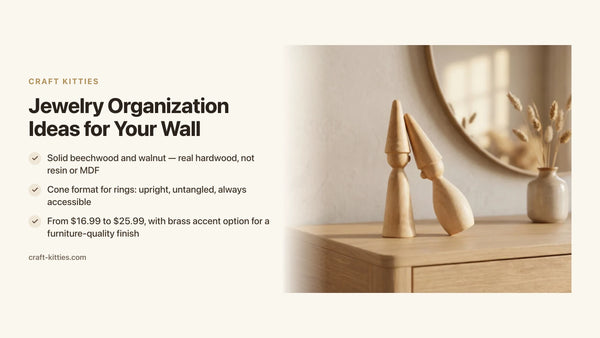
- Solid beechwood and walnut — real hardwood, not veneered or composite
- Cone form separates rings cleanly; tray form catches everything else
- From $16.99 for a paired set, $25.99 for the walnut-and-brass single
The nightstand or dresser corner is one of those spots in a home that either works or quietly frustrates you every single day. Rings slide off the edge. Earrings disappear under things. The watch ends up next to the phone, on top of yesterday's receipts. What is missing is not more surface — it is a deliberate small object that gives each piece a place.
A wooden trinket tray or ring holder is that object. It occupies almost no real estate, it is the first thing you reach for when you undress and the last thing you touch before you leave. And because it sits in plain sight on a surface you look at every day, the material it is made from matters more than it might on a piece of furniture hidden in a closet.
This guide covers what to actually look for when buying one: wood species, form factor, surface and scale. It presents the pieces from our ring holder collection with their prices and a comparison table, then answers the questions that come up most.
One note before starting: everything here is solid wood. Beech and walnut, not composite board with a printed grain. The difference is not just aesthetic — solid wood does not chip at the edges, does not react badly to skin oils or ambient humidity, and it develops a quiet patina instead of a faded surface. That distinction shapes every recommendation below.
At a glance
- Solid beechwood and walnut — real hardwood, not veneered or composite
- Cone form separates rings cleanly; tray form catches everything else
- From $16.99 for a paired set, $25.99 for the walnut-and-brass single
The two forms: cone versus tray, and when to combine them
A wooden trinket tray is a flat or shallow vessel. It collects everything at once — rings, earrings, a key fob, a watch clasp — in a single catchall that you can see across from the door. Its advantage is breadth: anything small goes in, nothing goes missing on the nightstand.
A ring holder cone is a vertical form. Rings slide down the taper and stay there, separated from each other and from other pieces. Its advantage is specificity: rings cannot press against each other, settings cannot snag, and pulling one ring off the cone is a deliberate movement, not a rummage.
The reason most people end up wanting both is that the two forms answer different problems. The tray handles the variety — earrings, a hair clip, a spare key, a folded receipt. The cone handles the jewelry that matters most. A cone placed at the center of a shallow tray is a classic arrangement: the vertical element gives height and visual structure, the flat surface around it catches the rest. If you wear rings daily and own more than three or four, you will likely find that a cone alone is not enough, and a tray without a cone turns into a pile.
Our pieces are sized for exactly that combined use. The cone sets sit steadily on a dresser or nightstand without tipping, and the walnut-and-brass piece is substantial enough to anchor a surface on its own.
Beechwood or walnut: choosing the species

The two species in our collection look different and behave identically. Solid European beech is pale — almost off-white, with a fine, even grain that reads quiet on a light surface. It does not compete with what is displayed on it, which is exactly the point for a piece whose job is to hold other beautiful things. On a white or light linen surface it nearly disappears; against a warm wood dresser it picks up a warm tone. It is the more neutral choice.
American black walnut is the opposite in palette: deep brown, with a grain that has character — tight, slightly varied, with the occasional darker streak that distinguishes it from the uniformity of stained wood. It reads like furniture. Against a lighter surface it is a clear focal point; on a dark surface it blends in without receding entirely. Walnut also develops a quiet patina as skin oils touch it over months and years, shifting from the initial cool-brown toward a warmer tone.
On every practical criterion the two species are close. Both are dense hardwoods — beech at around 43 lbs per cubic foot, walnut slightly lighter at around 38. Both are finished with a smooth matte coat that resists the everyday contact of jewelry metal, skin oils and bedroom humidity without needing periodic re-oiling or re-waxing. The weight of the pieces feels right in hand: heavier than a plastic or resin tray by a meaningful margin, which is the first thing most buyers notice when they take one out of the box.
The reliable rule: pale, light surface — choose walnut for contrast. Darker or warmer surface — choose beechwood so the piece reads against what surrounds it rather than disappearing into it. The brass-base walnut piece is the exception: the brass does the contrast work on any surface, so the walnut reads as material rather than tone.
A note on scale and placement
Wooden ring holders occupy very little space. The cone set sits within a roughly 3" × 5" footprint; the walnut-and-brass piece is similarly compact. They are designed for surfaces where every inch is already spoken for — the 8" of nightstand next to a lamp, the 6" of dresser corner next to the mirror.
That compactness is deliberate. A piece that takes up too much surface starts to feel like clutter rather than organization. The test is simple: after you set it down, does the surface look more organized or less? If the holder becomes one more object competing for space rather than a collector of objects, it is the wrong scale.
These pieces pass that test. They are small enough to share a nightstand with a phone, a glass of water and a lamp without crowding the space. And because they are made of real wood, they look like décor rather than storage hardware — which is the other reason they work in rooms where aesthetics matter as much as function.
The pieces from our studio

Description
The beechwood cone set is the entry point and the most versatile piece in the collection. Two cones, solid European beech, matched in finish and scale — one sits on each side of the nightstand, or they live together on a dresser as a small display unit. The paired format makes it the natural choice for couples who want an organized surface that does not require splitting one piece between two people. The pale beech grain stays neutral against almost any backdrop, which means it works in a bedroom or dressing area without needing to match a specific palette. At $16.99 for the set, it is also the most immediate answer to the question "where do I put my rings at night."

Description
The walnut-and-brass piece is the single most deliberate object in the lineup. Solid American black walnut on a solid brass base — two materials that complement each other without competing. The brass disk adds visual weight at the base and creates enough contrast that the piece functions as a small sculptural object as well as a ring holder. It is the right choice for a dresser where one statement piece is more appropriate than a set. At $25.99, it is the highest-priced piece in the collection and the one that reads most clearly as a gift object — the weight, the material contrast and the precision of the form all communicate that it was chosen with intention.

Description
The walnut set of two sits between the beechwood pair and the brass-base single: solid walnut in a two-cone format, without the metal accent. The raw walnut finish lets the grain read directly — no base element competes with it — which some buyers prefer on surfaces that already have metal elsewhere (lamp bases, drawer pulls, mirror frames). At $18.99 for the pair, it gives you the walnut tone and the paired format at close to the price of the beechwood set. The two cones can be used together or separated to different surfaces.
Comparison table
| Piece | Price | Wood | Format | Best for |
|---|---|---|---|---|
| Beechwood Cone Set | $16.99 | Solid European beech | Pair of cones | Couples, neutral palettes, first ring holder |
| Walnut + Brass Single | $25.99 | Solid American black walnut | Single cone, brass base | Statement dresser piece, gift |
| Walnut Cone Set of 2 | $18.99 | Solid American black walnut | Pair of cones | Walnut tone without accent metal, pairs |
Decision matrix — which piece for which situation
| Your situation | The right pick |
|---|---|
| Light or neutral bedroom, you want something that does not compete visually | Beechwood Cone Set — $16.99 |
| One deliberate piece for the dresser — quality over quantity | Walnut + Brass Single — $25.99 |
| Walnut tone but the surface already has metal accents nearby | Walnut Cone Set of 2 — $18.99 |
| Two people sharing one nightstand | Beechwood Cone Set or Walnut Cone Set of 2 |
| Gift for someone who wears jewelry daily | Walnut + Brass Single — $25.99 |
How surface finish changes the daily experience

The finish on a wooden ring holder does three things, none of which are visible in a product photo. First, it seals the wood fibers against the oils that transfer from skin every time a ring is placed or lifted. Without a finish, the wood around the base of the cone would darken unevenly within weeks of daily use — the way an unfinished wood handle on a kitchen tool eventually turns a different color where your hand grips it.
Second, a sealed surface handles bedroom humidity without swelling. Nightstands and dressers live in rooms where humidity shifts — after a shower, in winter with indoor heating, overnight. A bare or poorly finished wood absorbs and releases that moisture, which over time can cause the cone to check (develop hairline cracks along the grain) or lose its taper's smoothness. Our cones are finished to prevent that.
Third, and the part that shows up in daily use: the smooth surface means rings slide on cleanly and lift off without resistance. An unfinished or rough cone can catch on a prong setting or a thin band. That is the kind of small friction that, repeated once a day every day, compounds into quiet annoyance. A properly finished piece removes it entirely.
The maintenance implication is simple: the finish does the protective work, and your contribution is a dry cloth once in a while. No oils, no waxes, no seasonal treatment.
Where to place a ring holder — surface, height and light
Where a ring holder lives in a room matters more than most buying guides acknowledge. The immediate answer is "dresser or nightstand," which is correct but incomplete.
A nightstand placement is for the ring you take off last at night and put on first in the morning — engagement ring, wedding band, a daily-wear piece. It should be within arm's reach of the bed, which means the piece needs a stable, non-tippy base. Our cones are base-weighted for exactly that: they do not topple if you reach for them in the dark.
A dresser placement serves a larger jewelry rotation. If you wear different rings on different days, the dresser surface is where the decision happens each morning. Here, the visual dimension matters more — you want to see what you own at a glance. A pair of cones gives each piece a dedicated position; the walnut-and-brass single gives the entire dresser surface a focal point.
One factor most buyers do not think about until after: light. A cone on a surface near a lamp or facing a window catches light differently than one tucked in a corner. Walnut's grain reads more richly in warm light; beechwood brightens in natural light and can look almost white in direct sun. Neither is wrong — but knowing how the piece will be lit in your specific space gives you a more accurate preview of how it will look than any product photo can.
Mistakes that cost you a good daily routine
Putting too many rings on one cone. The cone is not a infinite stack — past seven or eight rings, removing one from the middle requires removing all the ones above it. Two cones solve this better than one overfull cone.
Choosing based on the photo background rather than your surface. A beechwood cone shot against a white ceramic dish on a white surface looks different from the same piece on a dark oak dresser. Before ordering, visualize the actual surface in your room — specifically its color and texture — and ask which wood creates more contrast there.
Using the holder only for rings. A cone can hold pendant necklaces draped over the point; a flat base can hold a small dish of earring studs alongside it. Thinking of the piece as only for rings undersells it.
Skipping a tray component entirely. A cone alone handles rings. It does not handle the earrings, the hair pins, the key you always lose. A small wooden tray alongside the cone handles everything else. The two-piece system — tray plus cone — is more useful than either alone, and at these prices ($16.99–$25.99 for the cone pieces), adding a small dish is not a significant extra cost.
Ring holder care — what it actually takes
The real answer is: almost nothing.
Wipe the cone with a dry cloth every few weeks. If something sticky transfers to it — hand lotion, perfume residue — a cloth barely dampened with water removes it cleanly. Let it dry fully before putting rings back on.
Do not soak it, do not expose it to standing water, do not put it in a bathroom that stays wet for long periods. This is a bedroom or dressing-area piece. The humidity of a closed bedroom is well within what the finish handles; the sustained dampness of a steam shower is not.
That is the entire maintenance protocol. No oils, no polishes, no seasonal rituals. The finish handles the protection; you handle the dust.
FAQ — wooden trinket trays and ring holders
1 — What is the difference between a trinket tray and a ring holder? A trinket tray is a flat or shallow vessel that collects everything at once — rings, earrings, small keys, loose items. A ring holder is a cone or upright form that separates rings vertically so they do not press against each other. Most setups work best with both: a tray as the catchall surface, a cone in the center for rings specifically.
2 — Is beechwood or walnut better for a ring holder? Both are solid hardwoods with comparable durability and finish. Beechwood is pale and fine-grained — neutral on any surface. Walnut is deep brown with a tight, characterful grain — it suits darker palettes and pairs naturally with brass or copper accents. Choose by contrast with your specific surface: walnut reads against light backdrops, beech disappears into them.
3 — Can I leave jewelry on a wooden ring holder every night? Yes. The matte finish resists skin oils and bedroom humidity. A dry wipe every few weeks is all the maintenance required. The finish was designed for exactly this use pattern.
4 — Will a wooden cone scratch my rings? No. The cone surface is sanded and sealed — no rough fibers or sharp edges that contact metal or stone. Rings slide on and lift off cleanly. Soft stones like opal or pearl should not be pressed hard onto any hard surface, but the cone itself presents no edge risk.
5 — How many rings fit on one cone? Typically five to eight, depending on band width. Slim stacking rings stack more; wide-band statement rings take more space per piece. If you wear more than six rings regularly, a paired set handles the volume better than a single cone.
6 — Does the brass base on the walnut holder tarnish? Solid brass develops a natural patina over time — many buyers consider this an improvement. To keep the original warm sheen, a soft cloth buff every few months is enough. No chemical cleaners needed.
7 — What wood is this — is it real solid wood? Yes. The beechwood sets are turned from solid European beech; the walnut pieces are solid American black walnut. Not veneered, not composite. The weight and density in hand confirm it immediately.
8 — Is a wooden trinket tray a good gift? Yes — and specifically for someone who wears jewelry regularly. It is used daily, visible on the dresser or nightstand, and the warm wood material reads as thoughtful rather than generic. The beechwood cone set ($16.99) works for couples; the walnut-and-brass single ($25.99) works as a standalone gift piece for someone with a deliberate aesthetic.
Where to go next
The ring holders here are part of our ring holder collection, which covers the full range from paired cone sets to individual display pieces. If you want to see the beechwood set first, the Beechwood Ring Holder Cone Set is the most immediate place to start. For a single piece that also works as a dresser focal point, the Walnut Wood Ring Holder with Solid Brass Base is the one we point to most.
You can also find our pieces on Etsy, where we have over 243 customer reviews from buyers who use them exactly as described here.
Conclusion — one small object, a surface that finally works
If there is one method this guide suggests: choose the form first (cone for rings, tray for everything else, ideally both), then choose the species by contrast with your surface. The beechwood set at $16.99 is the right answer for most nightstands and most palettes. The walnut-and-brass single at $25.99 is the right answer when one deliberate piece is what the surface needs, or when the gift has to read as considered rather than convenient. Either way, the object that earns its spot is the one you still reach for every single morning — and these do.