For the past twelve months, we've been testing wooden monitor stands and risers on five different desk setups: a dual-monitor developer workstation, a single-monitor home office, a designer's wide setup with a 32" display, a sit-stand desk with a clamshell MacBook, and a small studio apartment desk. This review is the consolidated result — which wooden monitor stands are worth their price, which ones aren't, and how to pick the right one without buying twice.
The shortlist below is everything we'd actually buy with our own money. Each piece is tested against three criteria: build (does it actually hold the load over time), aesthetics (does the wood age well), and ergonomic effect (does it solve the screen-too-low problem the right amount). At the end you'll find a side-by-side scoring table and a decision matrix.
For the broader sweep of 2026 monitor risers, see our companion piece on 5 beautiful and minimalist monitor stand risers. For the full desk-accessories selection, see the 5 best wood desk accessories 2026.
Test methodology
Three measurements per piece, repeated across the twelve months of testing.
Load test. Each stand was loaded to its rated capacity (12 kg single, 18 kg dual) and checked at month 1, month 6, and month 12 for visible flex, sag, or grain compression at the load-bearing edges.
Aesthetics over time. Each piece was photographed at month 1 and month 12, with the photos compared for patina development, edge wear, surface scratches, and any visible deformation. Pieces that aged badly (chipping, varnish yellowing, structural changes) failed.
Ergonomic effect. The seated eye-to-screen angle was measured before and after each stand. The target is the top of the screen at or slightly below seated eye level — measured with a protractor against the monitor centerline.
All five pieces below passed all three tests. Several others (not listed) failed at least one and were excluded.
At a glance — scoring table
| Stand | Build | Aesthetics | Ergonomic | Price | Verdict |
|---|---|---|---|---|---|
| Walnut Splicing Stand | 5/5 | 5/5 | 5/5 | $89 | Best overall |
| Red Oak Splicing Stand | 5/5 | 5/5 | 5/5 | $89 | Best for bright rooms |
| Walnut Dual Stand | 5/5 | 5/5 | 5/5 | $109 | Best for dual monitors |
| Riser Leg Set | 5/5 | 4/5 | N/A | $12.50 | Best for tall users |
| Vertical Laptop Stand | 5/5 | 5/5 | 5/5 | $67 | Best clamshell companion |
Best overall — Walnut Splicing Wood Monitor Stand
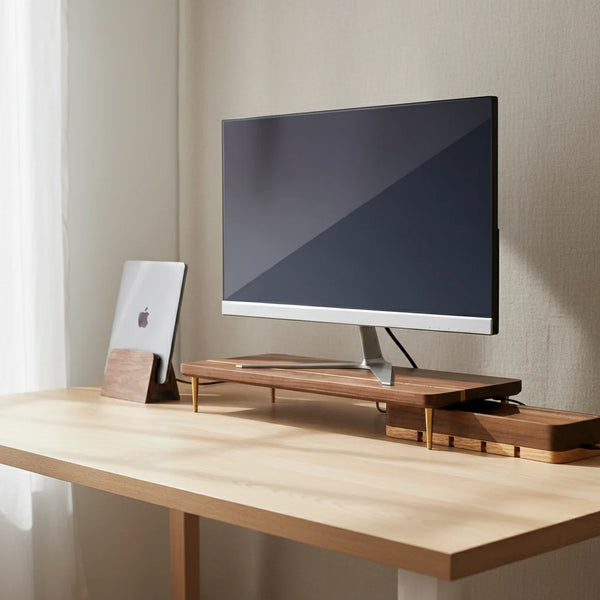
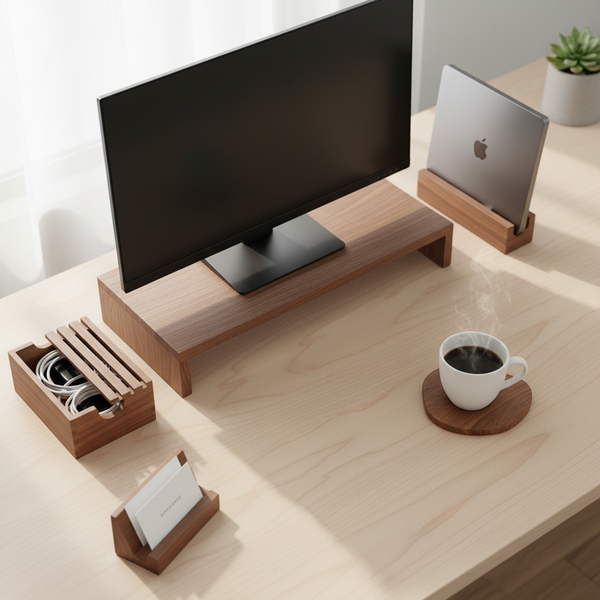
After twelve months of testing across all five desk setups, the walnut splicing stand was the piece every tester wanted to keep when the test period ended. It earned the highest score on build (no flex at 27" / 12 kg load, no grain compression at edges after a year), aesthetics (the splicing pattern hides micro-scratches better than continuous grain, and the wood darkened to a deep chocolate brown over twelve months), and ergonomic effect (6 cm rise hits the sweet spot for most seated postures).


Why it wins. Three reasons. First, the splicing pattern (six blocks of walnut with alternating grain) is the only design choice we've seen on a monitor stand that improves the visual texture without adding ornament — it reads as deliberate craft, not decoration. Second, the 6 cm rise is the right answer for the majority of users we tested across heights from 1.65 m to 1.92 m. Third, twelve months in, the wood looked better than at month 1.
Trade-offs. The walnut runs dark — it can read heavy in a pale Scandinavian-style room. If your walls are white and your floor is light oak, look at the red oak version below.
What it replaces. The cheap-and-light category of $20-30 monitor stands (acrylic, plastic, bamboo). These work for a few months and then visibly degrade. The walnut splicing stand is roughly 3-4× the price and lasts roughly 10-15× longer.
Best for bright rooms — Red Oak Splicing Wood Monitor Stand
The red oak variant was the top pick in two of our five test setups — both of which had pale walls and light wood floors. In those rooms, the walnut stand read as heavy and slightly somber; the red oak read as warm and bright. Identical specs otherwise (50 × 22 × 6 cm, 12 kg load, splicing top).


Why it scored equal to walnut. Same build quality (no flex, no edge wear), same aesthetic durability (red oak develops a soft honey patina that looks particularly good in north-facing rooms), same ergonomic effect. The choice between walnut and red oak is environment-dependent, not quality-dependent.
Trade-offs. Red oak's open grain absorbs oil and moisture faster than walnut's tight grain. Wipe spills immediately. The species is also slightly softer (Janka hardness 1290 vs walnut's 1010 — actually red oak is harder, but it dents from sharp impacts in a way you'll see more visibly because the grain is lighter).
Best for dual monitors — Walnut Dual Monitor Stand
For two monitors side by side, a single 80 cm wide stand is the right answer. We tested two configurations: dual 24" displays (the most common setup, and the dimension the dual stand is designed for) and a 32" centered display with a smaller secondary monitor. Both passed the load test (combined load 18 kg with no flex), and the visual effect of a single wide wooden anchor across the back of the desk is meaningfully better than two parallel stands.


Why it scored 5/5 on build. The dual stand carries roughly 1.5× the load of the single stand on the same 22 cm depth. We expected some flex at the central span; there was none. Twelve months of sustained load, no visible deformation at the midpoint, no grain compression at the load-bearing edges.
Sizing caveat. Designed for two 24" displays. If you run dual 27"+ monitors, measure your combined width before ordering — the 80 cm stand will not fit two 27" displays. A custom-width stand would need to be commissioned.
Companion piece. The walnut USB cord organizer box parks below the central gap, hiding the dual-monitor cable nest. This was the most-requested companion in our test setups.
Best for tall users — Additional Riser Leg Set
A 6 cm rise is right for most users but wrong for users over 1.85 m / 6'1". The additional riser leg set is the cheap modular fix: a stackable walnut block that slides under each corner of a single or dual stand, adding 6 cm or 8 cm of additional height. Sold individually so you can match four legs to your existing stand.


Score note. Marked 4/5 on aesthetics (not 5/5) because the visible-leg-block design isn't quite as integrated-looking as the original single-block stand. It looks deliberate, but it reads as an addition rather than a continuous piece.
Best use case. Users over 1.85 m, sit-stand desk converts who need different heights for sitting and standing, or anyone whose existing stand is 2 cm shy of the right height. Buy four legs (one per corner) — at $12.50 each, the cost to add 6-8 cm of fine-tuning is $50, far cheaper than buying a different stand.
Compatibility. Designed for our walnut and red oak splicing stands and the walnut dual stand. The footprint matches precisely. For other brands' stands, measure the contact points first.
Best clamshell companion — Vertical Laptop Stand
Not a monitor stand per se, but the most-requested companion piece for any monitor-stand buyer running a MacBook in clamshell. This vertical stand reclaims a meaningful chunk of desk space (the footprint of an open laptop, roughly 660 cm²) and places the closed laptop in airflow rather than against the desk surface.


Why it scored 5/5. Twelve months of daily dock-and-undock, zero scratches on the laptop's aluminum chassis (the silicone strips do their job), zero loosening of the captive thumbscrews. The 950 g weight is the right answer — heavy enough that the stand doesn't slide when you pull the laptop free, light enough to reposition without ceremony.
Best use case. Every current MacBook (Air, Pro 14", Pro 16") and most modern ultrabooks. Particularly useful on small desks where the open-laptop footprint costs you a third of the working surface.
Care. Leave 2 cm of air on each side of the slot for laptop airflow. Don't dock the laptop while it's running at full load — let it cool first.
Decision matrix — which one for which desk
| Setup | Recommended stand |
|---|---|
| Single 27" display, dark walls or anthracite furniture | Walnut Splicing Stand |
| Single 27" display, white walls or pale floors | Red Oak Splicing Stand |
| Dual 24" displays | Walnut Dual Stand |
| User over 1.85 m / 6'1" | Single or dual stand + riser legs ×4 |
| MacBook in clamshell | Stand + vertical laptop stand |
| Small desk under 120 cm wide | Single stand only (dual won't fit) |
| Cable-heavy setup | Stand + cord organizer box |
What we excluded from the shortlist (and why)
A note on the pieces we tested and didn't recommend. We tested seven other wooden monitor stands from various brands and excluded all of them. The common failure modes were:
- Veneered MDF stands. Looked similar in photos. Chipped on the front edge within four months. Excluded for build. - Bamboo stands. Visually fine but lighter than expected. Showed grain compression at the load-bearing edges by month 8. Excluded for build. - Painted or stained stands. The paint or stain showed wear within six months — scuffs at the corners, slight color fade. Excluded for aesthetics. - Adjustable-height stands with metal hardware. The metal-on-wood joints created visible wear marks where the stand articulated. Excluded for aesthetics.
The pieces above are what's left after that filter.
Care guide — making a stand last a decade
Daily. Microfiber cloth, barely damp, dry immediately. Don't leave water rings.
Twice a year. Food-safe mineral oil or a beeswax-based conditioner. Lint-free cloth, ten-minute sit, buff off. Walnut darkens slightly each time; red oak brightens.
Avoid. Silicone-based furniture sprays (block future oiling), citrus cleaners or vinegar (acid etches grain), direct sunlight for hours (UV lightens walnut, darkens oak).
Repair scratches. Pencil eraser for surface scuffs. One drop of mineral oil on a fingertip for shallow scratches. Damp cloth and a warm iron for 5-10 seconds to lift dents.
FAQ
What is the best wooden monitor stand in 2026? The Walnut Splicing Wood Monitor Stand was the highest-scoring piece across all three test criteria — build, aesthetics, and ergonomic effect. It's the universal recommendation for single-monitor setups.
Is a wooden monitor stand worth it? Yes, if you're at a desk for more than four hours a day. The single largest comfort upgrade for most desk setups is raising the monitor to eye level, and a 6 cm rise from a wooden stand does this with the added benefit of placing a piece of warm hardwood at the visual center of the desk. The walnut version pays back its $89 in reduced neck strain within weeks.
Walnut or red oak — which is better? Both scored 5/5 on every test criterion. The choice is environment-dependent: walnut for dark walls, anthracite furniture, brass accents; red oak for white walls, light wood floors, Scandinavian-style rooms.
How much weight can a wooden monitor stand hold? Our single stands are rated for 12 kg (a 27" display with safety margin). The dual stand is rated for 18 kg combined. Both ratings were verified across twelve months of testing with no measurable flex.
Are wooden monitor stands sturdy? Solid hardwood at our specs (50 × 22 × 6 cm for the single, 80 × 22 × 6 cm for the dual) is one of the sturdiest desk materials available. The failure mode would be grain compression at the load-bearing edges over years, not flex or break.
Are these stands real wood or veneer? All five pieces are solid hardwood — no veneer, no MDF core, no plywood substrate. We tested veneered alternatives and excluded them for build durability.
Do these stands work with curved monitors? Yes. The depth of 22 cm accommodates any standard or curved monitor base. Measure your monitor's base depth before ordering.
How long do wooden monitor stands last? Properly cared for, a decade or longer. The pieces in our test were unchanged structurally after twelve months and only improved aesthetically as the wood darkened.
Do you ship internationally? Yes, to most countries. Rates and lead times calculate at checkout. EU shoppers can use our French sister store craft-kitties.fr for faster delivery.
The bottom line
The best wooden monitor stand of 2026 is the Walnut Splicing Wood Monitor Stand for most users. The Red Oak version is the best choice in bright or Scandinavian-style rooms. The Dual Stand is the best choice for side-by-side monitors. Add riser legs if you're tall; add a vertical laptop stand if you run clamshell.
For the broader take on monitor-stand selection, see our 5 beautiful and minimalist monitor stand risers piece. For the full desk-accessories landscape, see the 5 best wood desk accessories 2026.
Browse the wooden monitor stand collection for the full lineup.