At a glance
- Observe the insect and growing medium before blaming the decorative pot.
- Check the plant’s actual nursery pot and visible water without dismantling roots.
- Keep wet care away from the wood exterior; unknown insects remain unidentified.
Tiny flies near a plant can be frustrating, but their location does not prove they came from the wooden planter or even from that plant. Start by observing where adults appear, what was recently watered, and whether the actual growing medium is damp or water remains at the base. Identify the insect before choosing a response; if you cannot, write “unknown” and seek plant-specific advice.
Record the insect and its location first
Look at the adults from a distance. Note their size and general appearance, where they gather, and whether they are around the plant, a window, a food-waste container, or another damp area. Do not call every small flying insect a fungus gnat. A plant location is a clue, not an identification.
Check whether there has been recent watering and whether a removable nursery pot sits inside the decorative outer pot. If there is a nursery pot, keep it outside the wooden cover during wet care. Inspect the nursery pot’s visible drainage arrangement rather than assuming that the decorative planter has holes. Ceramic material by itself does not establish drainage, and no product evidence here proves a hole in an insert.
Check growing-medium moisture without dismantling the plant
Observe the medium’s surface and the safely visible base area. Is there standing water? Is the potting mix still wet after recent watering? Is plant debris sitting on the surface? Record what you can see, and do not dig into the roots, pull the plant out by force, or leave it to dry for a guessed number of days. Different plants and growing conditions call for different care.
The Royal Horticultural Society explains that fungus gnats thrive in damp organic growing media; its guide uses this as a reason to inspect the growing environment, not the decorative wood. Read the RHS fungus gnat guidance. UC IPM also recommends inspecting houseplant conditions and links plant decline to water, drainage, and light; see its houseplant problem guide.
Use a nonchemical observation table
The cases below are hypothetical examples, not identifications or treatment tests. Keep uncertain fields unknown instead of filling them with a guess.
| Observation | Growing-pot location | Plausible source | Safe nonchemical check | What remains unknown | Expert next step |
|---|---|---|---|---|---|
| Small flies repeatedly appear at a plant with damp mix | In or around removable nursery pot | Damp organic medium is one possibility | Note watering date and visible moisture; observe where adults gather | Species, larval presence, exact source | Ask a local extension service or plant specialist if identification matters |
| Flies appear near a dry plant and also by food waste | Not clearly limited to the growing pot | Another indoor source may be involved | Compare where adults are seen; inspect the other area without moving the plant | Whether the plant is involved at all | Identify the insect before selecting any treatment |
| Water is visible in the outer planter after watering | Outer decorative pot, not proof of insert drainage | Retained runoff may be contributing to damp surroundings | Remove the nursery pot if designed to be removable and inspect the visible base | Whether the insert has drainage openings | Check product/maker instructions and the plant’s care guidance |
| Leaf growth looks soft or plant appears stressed | Growing medium state not yet known | Multiple plant-care factors are possible | Record medium moisture and recent watering without disturbing roots | Plant species and cause of symptoms | Ask a plant expert with photos and care history |
Separate the live plant from the decorative cover
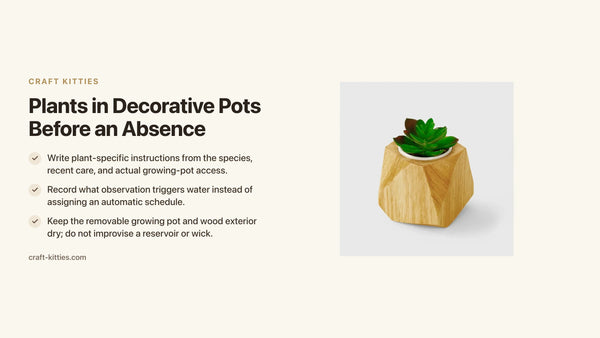
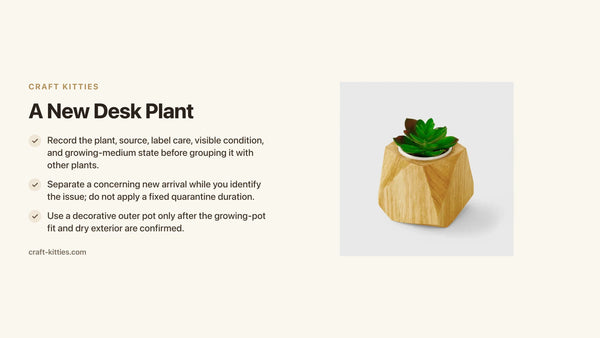
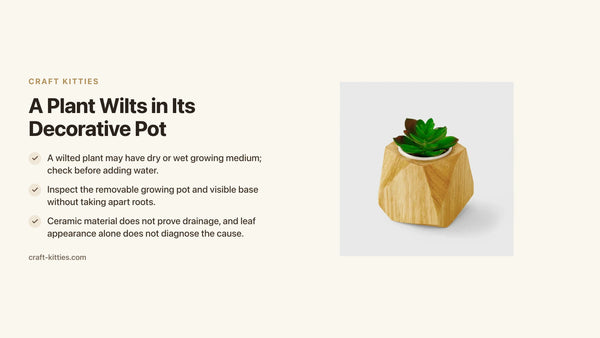
If the product uses a removable inner pot, lift it only if it comes out freely and the plant is safely supported. Do wet care away from the wood exterior and return a dry outside pot only after checking that no water is trapped beneath it. The listing for the rubberwood plant pot describes an inner ceramic cup with stated dimensions of 57 mm diameter and 62 mm depth, and a 110 × 80 × 80 mm outer size. These figures do not prove a drainage hole or the fit of every nursery pot. Ask the maker if the actual growing pot does not fit or remove normally.
A desk planter is a display container, not an insect treatment. Our biophilic home décor guide and walnut pencil holder guide address room styling and desk organization, not pest diagnosis.
Stop before introducing a treatment
Do not add sand, cinnamon, peroxide, neem, or pesticides based on an uncertain insect name. Do not deliberately dry a plant for a universal period. First identify the insect and follow plant-specific advice. If the plant is declining, the growing medium remains wet, or the insect is not identifiable, ask an extension service or qualified plant professional what information they need.
Compare the plant area with other possible sources
Keep the plant in place while you observe where adult insects gather over ordinary room use. Check for another nearby source such as damp food waste or a drain without assuming either is responsible. Record separate sightings by location and time. If the insects appear at several points, that weakens a confident plant-only attribution; it does not identify the species.
If you do not recognize the adult insect, take a clear photo from a safe distance for identification. Avoid trapping or handling insects unless a local expert recommends it. Your record can include the photo filename, watering date, and medium condition; leave larvae, species, and cause as unknown until confirmed. The RHS and UC IPM references support looking at damp growing medium and overall plant conditions, but neither source proves these particular insects came from this planter.
Only after a reliable identification should you decide whether any intervention is appropriate. This article intentionally stops before pesticides or home remedies. Keep the plant’s care instructions and the indoor insect question separate so an uncertain sighting does not lead to an unsuitable watering change.
Repeat observation without changing the plant routine
Keep the plant’s normal care instructions unchanged while you note whether sightings continue. Changing watering, moving the plant, and applying a remedy at the same time would make it harder to learn which condition mattered. This is not an experiment or a reason to delay plant care that the species needs; follow its normal guidance and document any required action.
Record the time and place of each sighting in simple language: “two small flies at window; none seen at plant,” or “insects repeatedly near the pot after watering; species not confirmed.” Avoid recording a species based only on a web photo unless you can confidently match it. If the plant seems affected or the insects are widespread, contact a local extension office with the observation and photo. If you use a removable nursery pot, continue wet care outside the wood and check the outside is dry before replacing it.
This short observation log helps separate a plant-related question from a room-wide insect issue. It still cannot identify larvae or prove that the wood planter caused the insects.

Description
FAQs
Are all tiny flies around a houseplant fungus gnats?
No. Observe their location and appearance, but leave the identification unknown until a reliable source or expert confirms it.
Does a wooden planter cause gnats?
The presence of insects near a planter does not establish that the wood caused them. Check the growing medium, other nearby sources, and the actual insect separately.
Should I let the plant dry out for a fixed number of days?
No universal duration is established. Plant species, potting medium, and conditions vary; use the plant’s care instructions and record observed moisture.
Does a ceramic insert guarantee drainage?
No. Ceramic material alone does not prove there are drainage holes. Inspect the actual insert or ask the maker.